
Where Can I Go to Buy a Used Car?
There are a number of options of places to purchase used cars, and each one has its advantages and disadvantages. Knowing this will help you to decide the best place to go for the car purchase.
Some of the places include:
Buying from a Dealership
Many buyers think of dealerships first, as it seems to be an easy and safe process. There is someone to do the paperwork, answer questions, and generally provide some type of warranty.
That additional security is important, especially if you’re not confident of checking the car yourself. The prices may be higher than an individual sale, but many buyers know the peace of mind is worth the money.
Buying from a Private Seller
A private seller can be a good choice if you want a fair price and a more relaxed buying experience. Most people selling their own car know its history well and can tell you how it’s been used day to day.
The downside is that you don’t get any legal cover once money changes hands, so you have to rely on your own checks and instinct. It’s important to meet in person, look through the documents, and take your time to run a check for outstanding finance, write off, theft, and more before agreeing to buy.
Buying from Online Marketplaces
Online ads provide you with an immense selection of cars to pick from, usually from both dealers and private sellers. It is a convenient method of price comparison, description reading, and understanding what you can buy with your budget.
But photos and descriptions do not necessarily give the complete picture, and it is necessary to have a look at the car before making any payment. To avoid unpleasant surprises, it is better to meet the seller in a safe place and check the history of the car.
Buying from Car Supermarkets
Car supermarkets can be handy because they keep many used cars on one forecourt, making it simpler to compare different models. The prices are usually fixed, which means there’s no bargaining, but you often get a standard inspection and warranty included.
Their stock tends to come from fleets or leasing companies, so most cars are well-maintained and only a few years old. It’s a good option if you want a choice without the pressure of dealing with a traditional salesperson.
Buying at Car Auctions
Auctions can offer some very tempting deals, but they work best for people who understand cars well. You often only get a quick look at the vehicle before it goes under the hammer, and once you buy it, the sale is final. So if you trust your judgement and stick to your budget, you might grab a bargain.
If you’re unsure, it’s wise to attend a few auctions first just to watch how they work. When ready, you should run a car auction history check to view the car’s past auction records and reveal any hidden records of write-offs, mileage anomalies, finance, scrap, and more.
What to Look For When Buying a Used Car
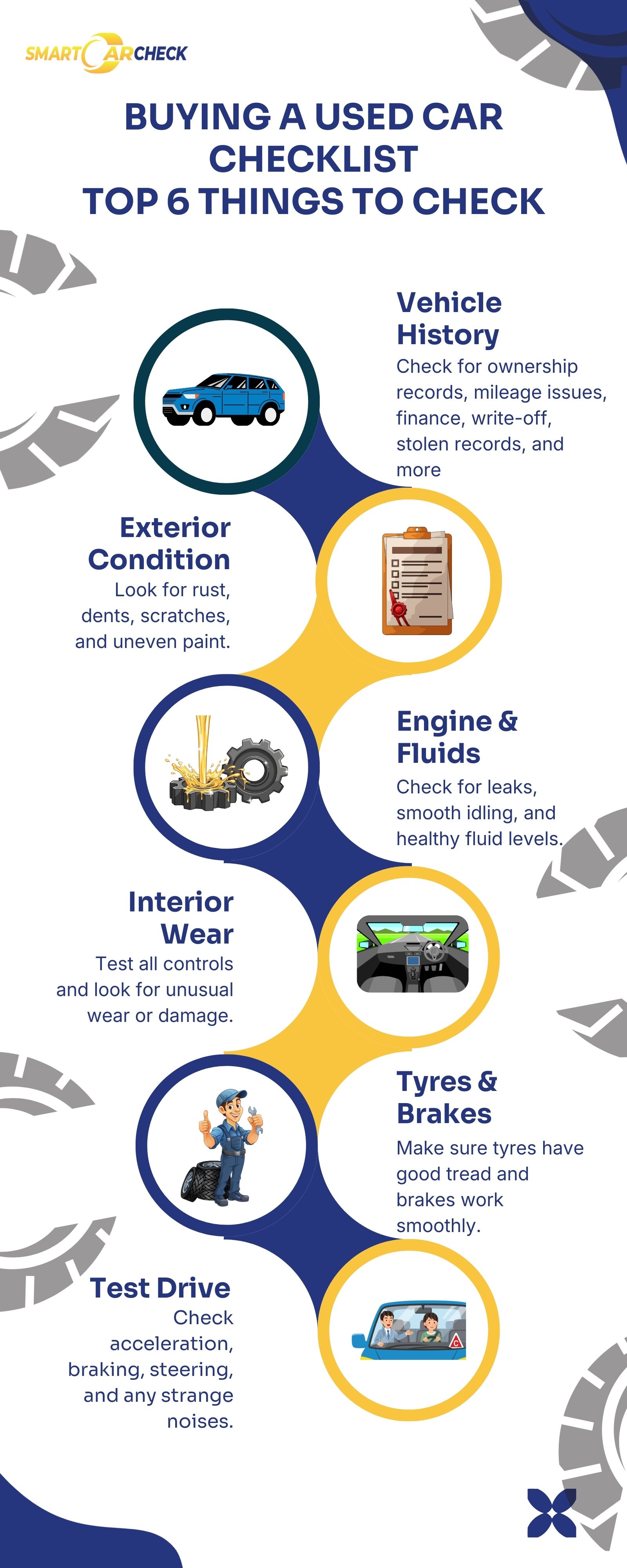
Before making any decision, you need to check the car carefully. A quick look is not enough. It’s better to take your time and save thousands later than to rush at the offer and regret it later. Here are what to check before buying a used car:
Exterior Condition
When approaching the car, look around it slowly. You are looking at dents, scratches, uneven paint and rust in areas such as the wheel arches or the bottom of the doors. When a panel appears a different colour than the rest, it might have been repaired due to an accident.
- Older cars are expected to have a few marks, but severe damage or rust might equal costly repairs in the future.
- Check the position of the car on the ground. When one corner appears to be lower, it could be an indication of a damaged spring of the suspension or damage in the past.
- See how the doors and the bonnet close; they must close without scraping or sticking. Anything that does not feel right might be an indication of bad repair or structural problems.
Interior Condition
Sit inside the car and spend a moment to see the way everything looks and feels. Worn seats, sagging headliners, or damaged plastics might suggest the car hasn’t been cared for.
Check that all buttons work:
- Windows should go up and down easily.
- Air vents should blow air, and the dashboard lights should behave as they should.
Pay attention to smells too:
- Damp or mouldy smells often mean water leaks, which can be difficult to fix.
- Look under the mats for signs of moisture and check the boot for damp patches.
A tidy interior usually hints at a careful owner, and that’s always a good sign. Though a clean interior doesn’t guarantee a perfect car, it adds confidence that the car was looked after.
Engine Bay Condition
Open the bonnet and check the following:
- Obvious issues like oil leaks, loose wires, or dirty fluid reservoirs.
- A bit of dust is normal, but heavy grime or wet oil patches aren’t.
- Check the engine oil colour and level if the seller agrees. A very dark or thick oil may show that it hasn’t been changed for a long time.
- Coolant should be clean and filled to the correct mark, not brown or low.
While the engine is running, observe the following:
- Listen for odd noises such as knocking, tapping, or whining. The idle should be steady rather than jumping up and down.
- Check for excess smoke from the exhaust, as blue or white smoke can point to engine trouble. You don’t need to be a mechanic to spot these things, as common sense goes a long way.
Tyres and Wheels
Go around the car and inspect all tyres. The legal minimum tyre tread depth is 1.6mm, and it must be worn evenly across as well. Lateral wear may indicate misalignment or that the suspension components are worn. Tyres having cracks, bulges, or extremely old manufacturing dates will require replacement in the near future.
Inspect the wheels to see whether they are damaged, particularly if the car uses alloy wheels. The deep scrapes or bends may indicate that the car has struck hard into the kerbs or potholes. Although damage to wheels does not necessarily imply that something serious happened, it informs you of how the former driver handled the car.
Underbody and Suspension
Crouch under the car and peep under it, where possible. You are inspecting rust, leaks, or hanging parts. Older cars have surface rust, but holes or flaking metal are significant issues. Check under the centre of the car, wet areas may be signs of a leaking engine or gearbox fluid.
When you push downwards on all corners of the car, it must bounce once and rest. When it bounces a number of times, the shock absorbers might be worn. A scraping sound whenever you move the car a little or turn the wheels is also indicative of worn-out suspension parts.
Mileage and Wear
The car’s condition and the mileage must be consistent with each other. A car that has a steering wheel or pedals that are in bad shape and have covered only a few miles can be an indication that the odometer is not telling the entire truth. High mileage is not necessarily bad, as a well-maintained car can run well after 100,000 miles. What is more important is the way the car has been serviced and driven.
Ask the seller how the car is usually used. Know that the short trips can be more demanding to the engine than the steady motorway work. Wear and tear in the car, clean interiors, and neat controls are all indications that the mileage is within the age and usage of the car.
Warning Lights
Insert the key into the ignition and observe the dashboard lights turn on before switching the engine on. All of them should briefly light up. Most of the lights should fade away in one or two seconds when the car is started. When the check engine, ABS, airbag, or oil pressure lights remain on, then you might be facing costly repairs.
Do not disregard the lights that turn off and turn back on when driving. Some sellers may wish that the buyer did not know what the symbols represent. In case something does not make sense, question the seller or leave in case the responses do not sound appropriate.
READ ALSO: How to Check True Mileage on a Car in UK
What Questions Should I Ask When Buying a Used Car?
Speaking to the seller gives you valuable clues about how the car has been handled. Honest sellers answer confidently, while dishonest sellers often struggle to give clear answers.
Here are the most important questions to ask:
Why are you selling the car?
How long have you owned it?
Has the car ever been in an accident?
Can I see the paperwork?
Is there any finance outstanding?
Can I see the full service history?
Are there any mechanical problems?
Does everything work inside the car?
When was the timing belt replaced?
Is there anything else I should know?
If the seller’s replies don’t appear to be true to you, you can get a quick number plate check online to check the ownership history, outstanding finance, theft, MOT history, mileage, V5C logbook records, and more. This will give you the confidence to make an informed buying decision.
What Documents to Check Before Buying a Used Car
You must not hand over the money unless you’ve checked all the paperwork carefully. You should take all the time to review the following documents:
V5C Logbook
The V5C logbook is the most significant document to examine, as it shows who the registered keeper is and establishes the identity of the car. Ensure that the name and address of the seller are the same as the name and address on the logbook.
Ensure that the VIN on the car is the same as the VIN number on the V5C because it is a major red flag when they are different. Be suspicious when the seller says they have lost the document, since without it, you cannot be sure that it belongs to you.
Before purchasing a vehicle, an online instant V5C logbook check can be used to verify the vehicle registration, ownership, and history. It will also ensure that the V5C information is the same, so that you do not purchase a stolen or cloned car.
MOT History and Certificate
Request the most recent MOT certificate and check when the next MOT is due. The certificate itself is useful, but the real value comes from reviewing the full MOT history online using our MOT check service.
This will show advisory notes, past failures, and patterns like repeated rust issues or brake problems. A clean, consistent MOT record usually suggests the car has been looked after.
Be wary of cars that have sudden mileage drops or years missing from the MOT history. Gaps could mean the car was off the road, badly damaged, or had the odometer tampered with.
Service History and Maintenance Records
A well-kept service history tells you how carefully the previous owner maintained the car. Look for stamps in the service book or printed invoices from garages showing oil changes, brake work, timing belt replacements, and other routine jobs.
Cars that are serviced regularly tend to last longer and have fewer hidden surprises. A full service history often adds value to the car, especially for higher-mileage vehicles.
Previous Owner Information
The V5C doesn’t show personal details about past keepers, but it does tell you how many owners the car has had and many other ownership records that can easily be accessed using an online car owner check tool.
Fewer owners often means the car has been kept longer by people who cared about it. A car with many short-term owners may have problems that people wanted to avoid.
Look at how long the current seller has owned the car to judge whether their story makes sense. If the car changed hands frequently in a very short time, ask why. Sometimes this happens with cars that develop issues soon after purchase.
Finance and Write-Off Checks
Before you buy any used car, make sure it’s not still on finance or listed as stolen. An outstanding finance check can reveal whether the car has unpaid loans attached to it, and if so, the finance company can legally take it back.
A write-off check can also show if the car has ever been written off by insurers and the Category (A, B, N, and S). Some write-offs are safe to buy, but others may have had serious structural damage.
These checks will also tell if the car has been imported, exported, or has a mileage discrepancy. These details help you judge whether the car is priced fairly. Spending a small amount on a proper check can save you thousands later.
Warranty Paperwork
A warranty is a money-saving tool and can go a long way if it’s still valid. In case the car still has a valid manufacturer’s warranty, request the documentation to verify it. There are warranties that automatically pass on to new owners, and some need the paperwork to be updated.
The fact that the car is still covered may provide you with additional assurance, particularly for expensive car models. Ensure that the warranty is not a fake one that has expired or become void as a result of non-service.
Should the seller provide his/her own warranty, read the fine print. Some offer limited coverage or force you to go back to a particular garage. Always enquire about what is and what is not covered.
READ ALSO: Essential Car Maintenance Checklist
What to Look for During a Test Drive
The test drive presents the best chance for you to see how the car behaves in real-world conditions. Take your time and drive on different roads. You should look out for these:
Engine Start-Up
Start the car from cold if possible. Blue smoke may mean oil burning, while white smoke could point to a blown head gasket. Watch out for:
- Loud knocking
- Rough idle
- Smoke from the exhaust
- Dashboard warning lights
Steering and Handling
Bad handling can mean tyre, suspension, or alignment problems. During the drive, check that the car:
- Doesn’t pull to one side
- Feels stable
- Responds smoothly to steering input
- Makes no clicking noises when turning
Brakes
Test the brakes gently and firmly. If the car pulls to one side when braking, there may be a brake or suspension issue. The brakes should:
- Respond quickly
- Feel smooth
- Not vibrate
- Not squeak loudly
Gearbox
Manual cars should shift smoothly. Automatic cars should not jerk, slip, or hesitate. Look for:
- Grinding
- Heavy clutch
- Difficulty selecting gears
Suspension
Drive over bumps or uneven roads. Worn suspension parts are expensive to fix.. Listen for:
- Knocking
- Squeaking
- Rattling
Acceleration
The car should pick up speed without hesitation. Slow response may indicate engine or fuel system issues.
Dashboard Lights
After the test drive, ensure no warning lights remain on.
Listen for “Hidden Noises”
Turn off the radio during your drive. Rattles, squeaks, whistles, or knocks often reveal hidden faults.
A Recap of What to Check When Buying a Used Car
Purchasing a used car can be simple and satisfying. The entire process is made easier and safer when you are aware of what to check when buying a used car. It is just about making a purchase choice, carefully examining the car, inquiring about its history, posing the correct questions, glancing through the paperwork, and, ultimately, testing the car thoroughly.
Take your time and make sure everything adds up. Since nothing good comes easy, any effort you put into checking, looking, and asking questions about the car can help avoid expensive mistakes and get a car that fits your budget, your needs, and your peace of mind.




