

Why Checking for Accidents Is Essential
Before you exchange your money for a used car, it’s important to know about its damage history. Now, let’s get real about why this matters so much.
It Saves You Money
Cars that have been in accidents are worth less money. Even if they’ve been repaired perfectly, they’ll never be worth what an accident-free car is worth. If you pay full price for a damaged car, you’ve been ripped off from day one.
The bigger problem is that repairs can look good on the surface but hide expensive issues underneath. That small crack in the chassis nobody mentioned? It’ll cost you three grand to fix when it fails your MOT.
Those headlights that don’t quite line up? The entire front end might need replacing in a year or two.
It Keeps You Safe
Your car is designed to protect you in a crash. The body panels fold in a specific way. The frame absorbs impact at certain points. When someone repairs accident damage badly, they mess with these safety features.
A bent frame won’t protect you properly in the next crash. Welded-together parts might snap when they should bend. Body filler can hide rust that’s eating through metal. These aren’t just mechanical problems – they’re life and death issues.
It Helps You Avoid Scams
Most sellers are honest people. But some aren’t. They’ll hide accident damage to get more money for their car. They might not mention that it was written off by the insurance company. They’ll tell you those mismatched panels are just from “a small car park scratch.”
In the UK, over 560,000 cars are written off every year. These are the cars the insurance companies decided weren’t worth fixing. Many of these get repaired anyway and sold on. Some repairs are done properly by professionals. Others are bodged together in someone’s garage.
Understanding Write-Off Categories in the UK
Before we get into checking cars, you need to understand how the UK classifies damaged vehicles. This’ll help you know what you’re looking at when you run a full car check online.
A “write-off” means an insurance company looked at a damaged car and decided it would cost too much to repair compared to what the car’s worth. That doesn’t always mean the car’s a total wreck, sometimes it just means the maths didn’t add up for the insurer.
We have four insurance write-off categories in the UK:
Category A – Scrap
This means the car is completely destroyed. Think of a car that’s been in a massive fire or a horrific crash. These cars must be crushed entirely. You’ll never see one on the road because it’s illegal to repair them. Every single bit goes to the scrapyard.
Category B – Break
A car in this category is slightly less severe but still serious. The car’s body is too damaged to fix, so it must be crushed. However, some parts might be okay, like the engine, gearbox, or doors. Salvage companies can sell these parts, but the main structure of the car gets destroyed.
Category S – Structural Damage
This replaced what used to be called Category C back in 2017. The S stands for structural damage. This means the frame, chassis, or other structural parts got damaged in the accident.
These cars can be repaired and put back on the road, but they must pass inspection first. They’ll always be marked as Cat S, which affects their value forever.
Category N – Non-Structural Damage
This replaced Category D, and the N means non-structural. The damage didn’t affect the frame or chassis – maybe the car got flooded, or the electrics got damaged, or the bodywork got smashed, but the structure stayed sound. These can also be repaired and driven again.
Cat S and Cat N cars are completely legal to buy and drive. Many of them get repaired properly and give their owners years of trouble-free motoring. But they’re worth less money than accident-free cars, and some insurance companies charge more to cover them.
READ ALSO: What Happens to My Insurance Policy if My Car is Written Off?
Can You Check If Your Car Has Been Involved In An Accident Online?
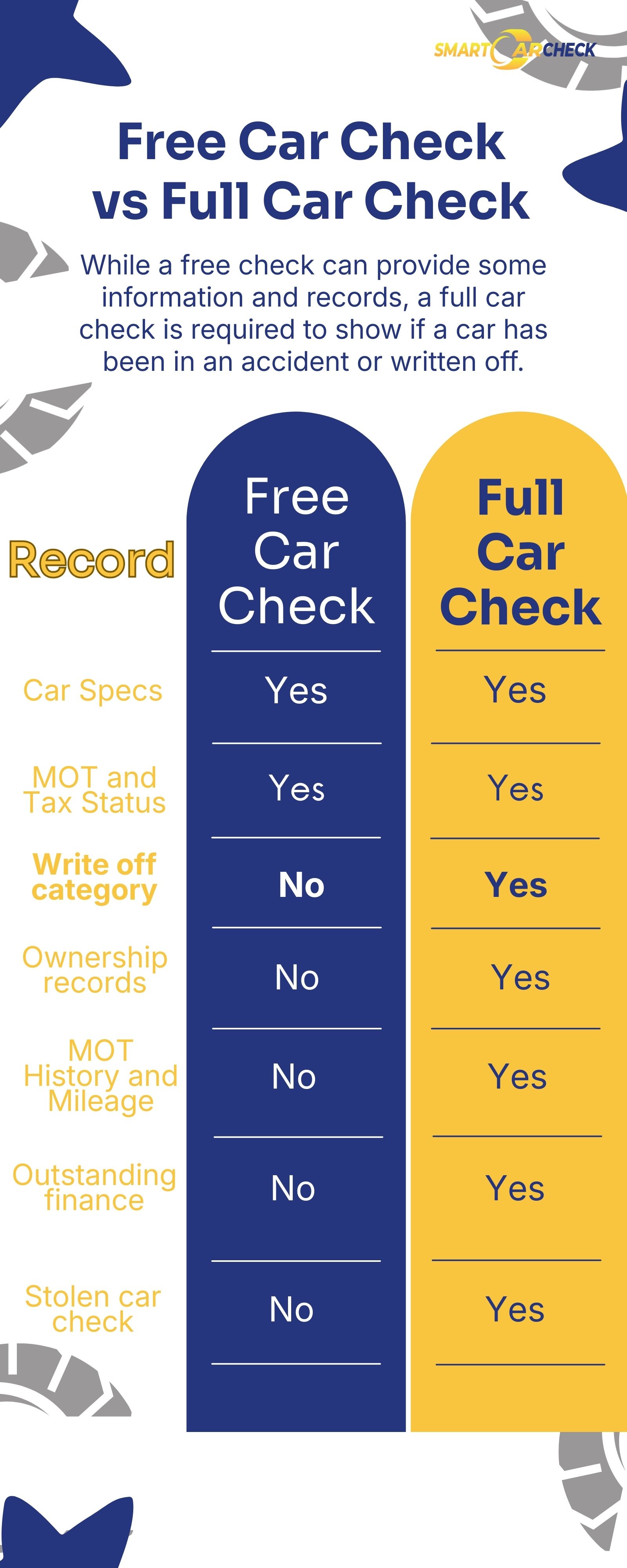
Right, let’s get practical. Your first step should always be running a full car check online before you even go to check the car. There is no a free car check to access accident history or insuranc write off in the UK – it’s only made possible with a paid check
Paid Vehicle History Check
This is where you get the good stuff. For around ten to twenty quid, these services search multiple databases and give you a proper report.
There are several providers in the UK but one of the big names is Smart Car Check whichl pulls used car records from trusted and reliable UK databases like DVLA (Driver and Vehicle Licensing Agency) and MIAFTR (Motor Insurance Anti-Fraud and Theft Register) to provide detailed car check reports for the general public.
What do you get for your money with Smart Car Check?
A whole lot as described below:
- The write-off category: if the car was ever written off. This is the gold dust information. You’ll see if it’s Cat A, B, S, or N, plus when it happened and roughly how much the damage cost.
- Insurance claims history shows if there were any claims made against the vehicle. Even if the car wasn’t written off, big insurance claims usually mean big accidents.
- The stolen car check tells you if the car was ever nicked. You don’t want to buy a car only to have the police take it away because someone stole it three years ago.
- Outstanding finance is crucial. If the previous owner bought the car on finance and didn’t finish paying it off, the finance company still owns it. They can repossess it from you, even though you bought it fairly.
- Mileage checks show the recorded mileage at every MOT. You can spot if someone’s wound back the clock – like if the car had 80,000 miles last year but the seller claims it’s only done 60,000 now.
- The number of previous keepers tells you how many people have owned it. Loads of owners in a short time can be a red flag.
You should know that a car check report will only show accidents that were reported to insurance companies. If someone dinged their car in a car park and paid a mate’s garage to fix it without telling their insurer, it wouldn’t show up. That’s why you can’t rely on online checks alone. You need to use your eyes, too.
READ ALSO: How to Change the Owner of a Car: EASIEST Guide
How to Check if a Car Has Been in an Accident: Physical Warning Signs
This is where you become a detective. Even if the online vehicle history report comes back clean, you need to inspect the actual car for signs of accident damage. These include:
Exterior Checks
You should watch out for the following by walking around the car:
Paint colour differences
These are usually the easiest giveaways. Walk slowly around the car in good daylight. Does one panel look a slightly different shade? Maybe the bonnet’s a bit more blue than the doors? Even professional resprays rarely match the factory paint perfectly.
Look at the texture, too. Factory paint is smooth and has a consistent shine. Resprayed panels might look more orange-peely or have tiny dust particles trapped in the paint.
Panel Gaps
This should be even all the way around. Crouch down and look at the spaces between the bonnet and the wings, the doors and the body, the boot and the rear panel.
If one gap is twice as wide as the other side, something’s not lined up right. That usually means the panel was removed and refitted – often because of accident damage.
Paint overspray
This is when you spot paint where it shouldn’t be. Run your finger along the rubber seals around doors and the boot. Feel any rough bits? Check the door hinges, the window rubbers, and even the tyres. Lazy repairers don’t mask things properly, so paint gets everywhere.
Cracks in the paint
This might mean there’s body filler underneath. Body filler is putty that repairers use to smooth out dents. It’s fine if done properly, but it cracks over time. Tap the panel gently with your knuckles – body filler sounds different from metal, more dull and flat.
New parts on old cars
This doesn’t make sense. If the car’s ten years old but one headlight looks brand new, why? If the front bumper is pristine but the rest of the car has scratches and chips, something’s been replaced. Ask why.
Cracked or scuffed bumpers
This often hides bigger damage. Modern bumpers are tough plastic, so if one’s cracked, it took a fair old whack. What else got damaged in that impact?
Under the Bonnet
Pop the bonnet and have a proper look around. You don’t need to be a mechanic for this.
Welding marks
These shouldn’t be there on most parts of the inner wings and chassis rails. If you see rough welds or fresh-looking metal that’s been welded, someone’s been repairing crash damage. Factory welds are neat and tidy. Backstreet welds look rough.
Bent or twisted metal
This is usually obvious once you know what to look for. The inner wings (the metal panels on either side of the engine) should be symmetrical. If one side looks bent or crumpled compared to the other, that’s front-end damage.
Aftermarket bolts
These look different from all the others might mean panels were removed and replaced. Factory bolts all match. If some are shiny silver and others are rusty, or some have different head shapes, parts have been taken off.
Handwritten numbers or marks
These found on parts usually mean they’ve been replaced. Breakers’ yards and repair shops write codes on parts they fit so they can track them. It’s not always bad, but it’s worth asking about.
Inside the Car
After checking the exterior parts, get inside the car and look out for the following:
The airbag warning light
The light on the dashboard should light up when you turn the key, then go off after a few seconds. If it stays on or doesn’t come on at all, the airbags might have gone off in a crash and not been replaced properly. This is seriously dangerous.
Split seams
Finding this on the airbag covers (in the steering wheel and dashboard) means the airbags deployed. They rip the covers when they inflate. Some repairers glue them back together, but you can usually spot the split if you look closely.
Dashboard alignment
This matters more than you think. If the dashboard doesn’t sit flush with the windscreen, or there are gaps where there shouldn’t be, the front end might have been pushed back in a crash.
Water stains
This on the carpets or headlining could mean flood damage. Some accident-damaged cars also end up flooded if they’re left outside for ages during repair. Flood damage causes electrical nightmares that’ll cost you a fortune.
Door and Window Checks
- Open and close every door, including the boot. They should shut with a solid thunk, not a rattle. If you have to lift or push the door to get it to close, the frame’s probably bent.
- Wind all the windows up and down. They should move smoothly without sticking or making grinding noises. Damaged doors often mess up the window mechanisms.
- Look at the glass itself. Each window has codes etched into the corner showing who made it and when. If one window has a different manufacturer or date code, it’s been replaced. One replaced window might just be vandalism. Multiple replaced windows could mean serious impact damage.
The MOT History Trick
Here’s a clever one that costs you nothing. Every MOT test gets recorded with the mileage and any advisories or failures. Go to the gov.uk MOT history checker and type in the registration. You’ll see every test since 2005.
Now look for patterns.
- Did the car suddenly miss an MOT? Say it was tested every year like clockwork, then nothing for eighteen months? That gap could mean it was off the road, being repaired after a crash.
- Check the mileage progression. If the car was doing 10,000 miles a year, then suddenly did only 2,000 miles one year, it might have been sitting in a garage being fixed.
- Look at the failure or advisory reasons. Did it fail for something serious like “excessive corrosion to nearside front suspension”? Then next year passes with loads of new parts fitted? Someone replaced damaged parts, possibly from an accident.
- Compare the failures year on year. Cars don’t usually develop front-end and rear-end problems at the same time unless something major has happened.
Getting a Professional Mechanic Inspection
Right, you’ve done your online checks and your visual inspection. Everything looks okay so far. Now here’s the best money you’ll ever spend: get a proper mechanic to check it.
Many mechanics offer pre-purchase inspections. You pay them around £100 to £150, they spend an hour going over the car properly, then they give you a written report.
What can they spot that you can’t? Everything, basically.
- They’ll get the car up on a lift and look underneath. That’s where dodgy repairs really show up. They’ll see if the chassis is straight, if there’s been welding, and if parts have been replaced.
- They use special tools like paint depth meters. These measure how thick the paint is. Factory paint has a consistent thickness. If one panel has paint twice as thick as the others, it’s been resprayed to cover damage.
- They’ll check the frame alignment with proper equipment. Your eyes can spot obvious problems, but mechanics can measure tiny differences that add up to serious issues.
- During the test drive, they’ll listen for noises that mean trouble. That clunk when you go over bumps could be suspension damage from an impact. The steering pulling to one side could be due to bent steering components.
A good mechanic inspection includes checking all the electronics, the underside, the engine bay, doing a road test, and looking for any signs of accident damage or poor repairs. They’ll tell you straight if the car’s been in a smash and whether the repairs were done properly.
If the seller won’t let you get a mechanic inspection, walk away. Honest sellers with nothing to hide don’t mind you checking properly.
Red Flags That Mean Walk Away Checklist
Some warning signs are so serious that you should just leave. Don’t try to negotiate. Don’t convince yourself it’ll be fine. Just walk away if these happen:
- The price is way below market value.
- The seller won’t let you get an inspection and pressure you to decide quickly.
- No service history at all on a car that’s more than a few years old is dodgy.
- The VIN on the car doesn’t match the VIN on the V5C.
- The seller can’t provide straight answers about the car’s history.
- Multiple paint colours under the bonnet or boot
- Signs of serious frame damage
Trust your gut feeling. If something feels wrong or your brain’s picked up on something dodgy, call it off. There’s always another car to look at.
What to Do If You Already Bought a Damaged Car
So you bought a car, and now you’ve discovered it was in an accident the seller didn’t mention. Don’t panic. You might have rights.
- First, work out if you bought from a dealer or a private seller. The rules are different. Dealers have much stricter legal duties under the Consumer Rights Act 2015. They must describe cars accurately, and they can’t hide important information about damage.
- Gather your evidence. Take photos of the damage or poor repairs. Get a mechanic’s report and print out the vehicle history report showing it was written off. Collect everything that proves the seller lied or hid information.
- Contact the seller first. Explain what you’ve found and what you want them to do about it. Maybe you want some money back, or you want them to take the car back completely. Be polite but firm. Put everything in writing – emails or letters, not just phone calls.
- If you bought from a dealer and they won’t sort it out, contact Citizens Advice. They can explain your legal rights and help you work out your next steps. You might be able to reject the car and get a full refund if you act quickly.
- For private sales, your rights are more limited. Private sellers don’t have to make sure the car is perfect. But they can’t lie to you. If they told you the car had never been in an accident and that turned out to be false, you might have a claim for misrepresentation.
- You might need to consider legal action through a small claims court. This costs money and takes time, so weigh up whether it’s worth it. Sometimes accepting a partial refund is better than spending months fighting in court.
Now that you know how to check if a car has been in an accident, learn from it. Next time you plan to buy a car, you’ll know to do all these checks first. It’s an expensive lesson, but you won’t make the same mistake twice.
Wrapping It Up
Right, let’s bring this all together. Checking if a car has been in an accident isn’t rocket science, but it does take a bit of effort.
The golden rule is that if something doesn’t feel right, walk away. There are millions of used cars for sale in the UK. If the one you’re looking at has dodgy history, mismatched panels, or a seller who won’t answer questions straight, just move on to the next one.
Take your time with this. Buying a car is probably one of the biggest purchases you’ll make apart from a house. Doing these checks properly might take a few hours and cost you. But that’s nothing compared to the thousands you could lose by buying a damaged car.




