

Let’s be honest: that annual MOT due date brings a specific kind of headache. You worry about the downtime, the difficulty, and most of all, the bill. But here’s the thing that always surprises us in the data room: nearly a third of all vehicles in the UK fail their MOT on the first attempt, often for silly little things you could have spotted in your driveway with a cup of coffee in hand.
We’ve seen it time and time again. A perfectly good car failing because of a blown bulb or a dry washer bottle. If you’re wondering “what do they check on an MOT?”, or you’re eyeing a used car and want to know if its current “Clean Pass” is hiding a rusty past, we’ve got you covered.
- The MOT checks safety and emissions, not the mechanical health of your engine, gearbox, or clutch.
- Simple things like lights, wipers, and registration plates account for a massive chunk of failures.
- A clean physical check doesn’t show you if the car might pass today, but checking its MOT history often reveals recurring issues like corrosion or electrical gremlins.
The Basics: What Does an MOT Check?
First off, let’s clear up a common myth. The MOT (Ministry of Transport) test is not a service. The tester isn’t there to change your oil or swap out your air filter. It’s strictly a safety inspection to ensure your vehicle meets the minimum legal standards for roadworthiness and environmental exhaust emissions.
So, what does an MOT check? It looks at vehicle safety, roadworthiness, and exhaust emissions at that specific moment in time. The tester isn’t allowed to strip the car apart; they can only inspect what they can see and access.
It’s a visual and functional check. If it affects your ability to stop, steer, see, or be seen, it’s on the list.
Pre-MOT Checklist
Preparing for the MOT test is crucial for ensuring that your car meets the necessary safety and environmental standards required for legal operation on public roads. Here’s the thing. Nearly 50% of faults could be avoided by a quick walk-around. You don’t need to be a mechanic to know what to check before an MOT.
Save yourself the retest fee and run through this list the morning of your test:
Lighting and Signalling
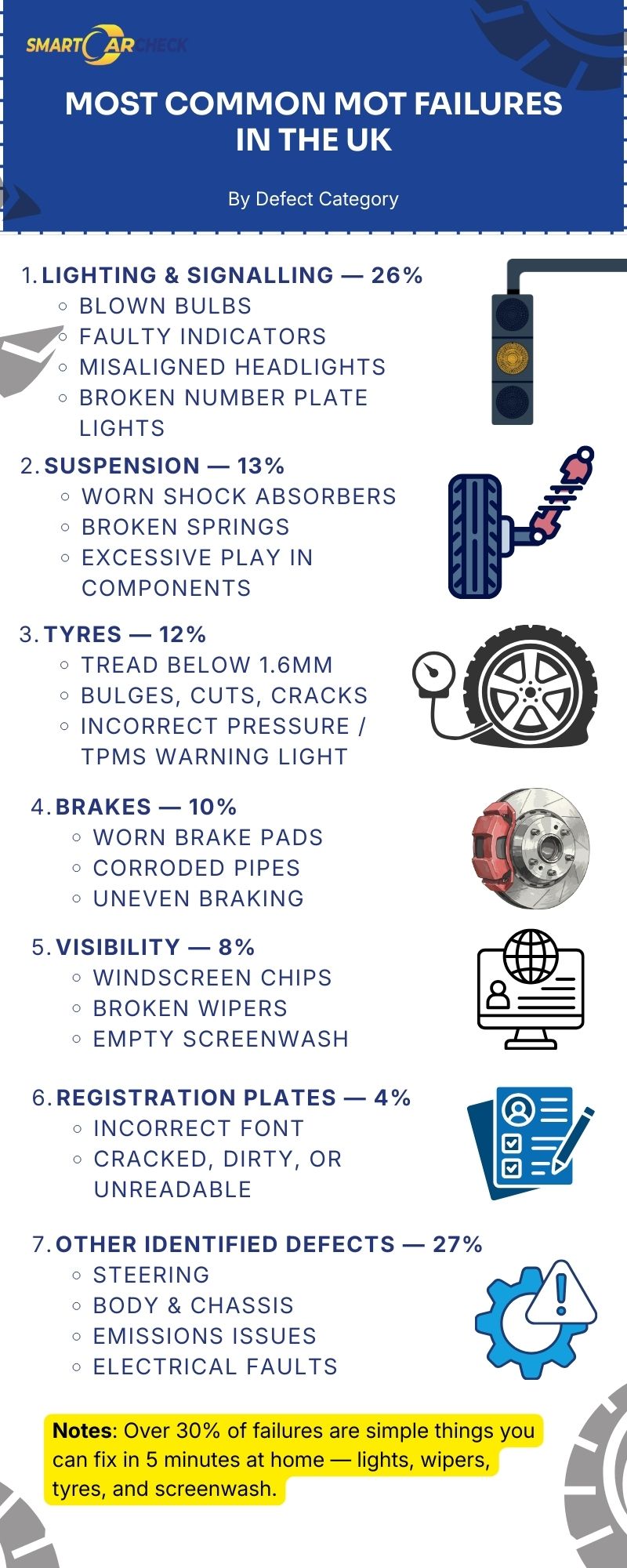
Statistically, lighting issues are the most common reason for an MOT failure. It’s almost embarrassing how many drivers get caught out here because they didn’t do a two-minute lap of the car.
What to check before the MOT test:
- Headlights and Main Beams: Turn them on and walk around. Are the lenses clear, or have they gone cloudy?
- Indicators: Check all four corners. If the ticking sound inside is racing, you’ve likely got a blown bulb.
- Brake Lights: This is tricky on your own. Back up to a garage door or a shop window and check the reflection, or just ask a mate to stand behind. Don’t forget the high-level strip light in the rear window. Testers often fail that one.
- Number Plate Lights: Often overlooked. Give them a tap; if they flicker, replace them.
- Fog Lights: You rarely use them, so you rarely notice when they die. Check the rear fog light specifically.
Pro Tip: Lenses need to be free of cracks. We once saw a car fail because of a piece of clear tape holding a lens together. It’s not worth the risk. Replace the unit if it’s cracked.
Tyres and Wheels
Tyres are the only thing keeping you on the tarmac, so the DVSA takes them very seriously. We look at thousands of reports a year, and the number of “dangerous defects” flagged on tyres is enough to make you cringe.
The critical checks:
- Tread Depth: The legal minimum is 1.6mm across the central three-quarters of the tyre.
- The 20p Test: Pop a 20p coin into the main tread grooves. If the outer band of the coin is obscured by the tyre, you’re generally safe. If you can see the band, you’re in trouble.
- Sidewall Condition: Look for cuts, bulges, or cracks. We often see tyres with plenty of tread fail because they have a “bubble” in the sidewall from hitting a pothole.
- Pressures: While pressure itself isn’t a direct fail unless it’s obviously flat, a tyre that looks soft will invite the tester to look closer.
- TPMS Light: If your dashboard is screaming about tyre pressure, that’s a fail. Top them up and reset the system.
Visibility: Windscreen and Wipers
You can’t drive safely if you can’t see the road, and you certainly can’t drive safely if other drivers can’t see your signals. This section of what they check for on an MOT covers the area that is probably the easiest for you to assess quickly at home, yet it still accounts for a massive chunk of annual failures.
It’s often the little things, like an empty screen wash reservoir, that trip people up. Don’t skip the easy fixes, we always advise.
What do they check in an MOT for visibility?
- Chips and Cracks: In Zone A, damage can’t be larger than 10mm (smaller than a 5p coin). Elsewhere in the swept area, you get up to 40mm. If you have a chip, get it filled before the test.
- Wipers: Do they clear the screen, or do they smear water across it? If the rubber is split or perishing, swap them out. It’s a five-minute job.
- Screen Wash: This is the silliest way to fail. If the washer bottle is empty, you fail. Top it up with proper screen wash, not just water.
- Mirrors: They need to be secure and the glass intact. A taped-on wing mirror might hold on the motorway, but it won’t hold up in the test bay.
Fluids and Under the Bonnet
You don’t need to be a mechanic to do this. You just need to know where the dipsticks are. While the tester won’t dismantle your engine, they will check for major leaks and levels.
Your checklist:
- Brake Fluid: Check the reservoir level. If it’s below the minimum mark, it’s a fail (and dangerous).
- Engine Oil: Ensure it’s topped up. The tester needs to rev the engine for emissions testing; if the oil is too low, they might refuse to run the test entirely to avoid blowing up your engine.
- Power Steering Fluid: Check the level and look for leaks around the pipework.
- Horn: Give it a blast. It needs to be loud and continuous. Novelty horns? Usually a bad idea if you want a pass.
Brakes and Suspension
You can’t easily check your own brake pads without taking the wheels off, but your car talks to you if you listen.
Listen for these signs:
- The Squeal: A high-pitched screech when braking usually means the pads are worn down to the metal.
- The Pull: Does the car pull to the left or right when you brake? That suggests a seized caliper or uneven pressure.
- Handbrake Tension: If you have to pull the handbrake lever up to your chin to stop the car rolling, the cable needs adjusting.
- Suspension Noises: Push down on each corner of the car and let go. It should bounce up and settle immediately. If it keeps bouncing like a trampoline, your shock absorbers are shot.
The “Invisible” Checks: History and Documentation
This is where Smart Car Check comes in. Physical checks are vital, but paperwork can be just as deadly. A vehicle might look clean, but if the VIN (Vehicle Identification Number) doesn’t match the logbook, you aren’t going anywhere.
What to do before MOT regarding history:
- VIN Match: Check the VIN plate (usually on the dashboard or door pillar) against your V5C logbook. They must match perfectly.
- Registration Plates: Are they clean? Is the font standard? We’ve seen cars fail for “3D carbon” plates that weren’t readable by ANPR cameras.
- Previous Advisories: This is your crystal ball. Look at your last MOT certificate. Did it mention “brake pipes slightly corroded”? If you haven’t fixed that in the last 12 months, it’s likely a fail this year.
- Checking the ‘unknown’ history: Before you spend hundreds on repairs, run a history check. We’ve seen owners prep a car for MOT only to find out later it was a Category S write-off with structural issues that make it a money pit.
Knowing the history, like mileage discrepancies that indicate clocking, helps you decide if the car is even worth the MOT fee.
Interior and Safety Systems
It’s easy to forget the inside of the cabin when wondering what they check for on an MOT, but safety starts in the driver’s seat.
Quick interior sweep:
- Seatbelts: Pull them all out sharply. They should lock. Check for fraying or cuts. Even a small cut in the webbing is a fail.
- Warning Lights: This is non-negotiable. If the ABS light, Airbag light, or Engine Management light is on, you will fail.
- Seats: They must be secure. If the driver’s seat rocks back and forth, it’s a fail.
What to Expect During the MOT Test
If you’ve never watched a test, it’s actually quite systematic. You’ll usually hand over your keys and wait in a designated viewing area (most garages have these now, because it’s a requirement).
It usually takes about 45 minutes to an hour. They are not allowed to dismantle anything. If they can’t see it (like a seatbelt buckle trapped under a heavy load in the boot), they can’t pass it.
What Happens After the MOT?
So, the test is done. You’re handed a piece of paper (A4, usually plain white these days). Since the rules changed back in 2018, understanding what’s written on that sheet is critical.
Understanding Your MOT Results
The old system was a bit vague, but the current one breaks faults down clearly. Here are the results of an MOT test in the UK
Pass with no defects
The golden ticket. Your car meets the minimum legal standards. Keep in mind, this doesn’t mean the car is “perfect”, just that it’s safe for now.
Pass with advisories
You’ve passed, but the tester has spotted things that are wearing out. Maybe your tyres are close to the limit (say, 2mm) or your brake pads are getting thin.
Our advice: Don’t ignore these. Advisories are just “fails in waiting.” Fix them before next year.
Pass with minor defects
These are issues that aren’t severe enough to fail the car, but they are technically defects. An example might be a slight leak in the exhaust that doesn’t affect emissions.
Action: You get a pass certificate, but you are legally required to get these fixed as soon as possible.
Fail
This is the part nobody wants. If you fail, the defects are categorized into two types:
- Dangerous defects:
This is serious. The car poses an immediate risk to road safety or the environment.
The Rule: You cannot drive the vehicle away. It must be repaired at the test centre or towed to a garage. Driving a vehicle with a dangerous defect is a criminal offence, which is a 3 penalty points and a fine of up to £2,500.
- Major defects:
These are significant issues (like a broken indicator or bald tyre) that cause a fail.
The Rule: You can drive the car away only if your current MOT certificate is still valid and the car is roadworthy. If your MOT has already expired, you can only drive it to a pre-booked repair appointment.
Next Steps Following a Failure
If you’ve failed the MOT test, here is a list you can follow to pass the next test:
Review the Failures
Look at the VT30 (refusal of an MOT test certificate). It will list exactly what failed. Ask the tester to show you the problem if you don’t understand it.
Get Repairs Done
You have the right to take your car to a different garage for repairs, provided it’s safe to drive (no dangerous defects). However, leaving it at the testing station is often easier.
Retest Your Vehicle
If you leave the car at the test centre for repairs, the retest is usually free (partial retest). If you take it away and bring it back within 10 working days, the retest fee is usually lower than a full test fee.
Beyond the Pass/Fail: Why MOT History Matters
After you know what things you need to check for an MOT, you will be aware of what will be evaluated during the test, as well as the potential outcomes detailed on the MOT certificate.
It’s important to note that an MOT certificate serves as a snapshot in time, indicating that the vehicle was compliant and safe on the day of the test. However, it does not assure the vehicle’s condition five minutes later, let alone six months down the line.
This is where the real work begins, especially for anyone looking to buy a used car in the UK. We’ve always said a quick car check by Reg number or a VIN number saves headaches down the road. Why? Because the most revealing details aren’t on the certificate itself, but in the vehicle’s history.
Advisory Notes
Every MOT failure or successful test can include advisory notes. The tester’s warning about components that are near the limit, like tyres approaching 1.6mm tread depth or brake pads that are running low. Buyers skip this and regret it every time.
Past Failures
Seeing a detailed list of past failures shows you recurring problems. Is the same axle always failing on balance? Does the car repeatedly fail due to suspension issues? This pattern reveals a potential chronic fault that a new pass certificate might temporarily mask.
Mileage Discrepancies
The MOT record includes the mileage recorded at every single test. This is arguably the most powerful tool against clocking (odometer fraud).
An MOT mileage check helps compare those recorded readings and spot sudden drops, gaps, or mileage inconsistencies before you buy. If the mileage suddenly drops between one year and the next, you have indisputable evidence of fraud.
Understanding Wear
By looking at the history, you get a much clearer picture of how well the previous keeper maintained the vehicle. Were they quick to fix advisories, or did they only do the bare minimum to scrape a pass each year?
Importance of Preparation for Future Tests
The best way to pass an MOT is regular maintenance, not a last-minute panic. We always tell drivers: treat your car like an investment. Servicing it on schedule prevents those “Major” defects from appearing.
Also, keep tabs on your mileage. We’ve flagged thousands of cars where the MOT history showed mileage discrepancies. A clear sign of “clocking.” If you’re buying a used car, checking the MOT records is the first thing you should do to verify the mileage is genuine.
Conclusion
Understanding what an MOT check covers is essential for any driver in the UK. It’s a vast, detailed list, designed to ensure safety and compliance, not mechanical perfection. From the meticulous checking of brake efficiency to confirming the legality of your number plates, the test is thorough.
But remember the critical distinction: a pass certificate is only the start. If you are buying or selling, or simply want peace of mind, verifying the full history is the non-negotiable next step. Get a MOT History report today. It’s how you turn a passing glance into a professional insight, ensuring you know exactly what kind of vehicle you’re dealing with.
FAQ About What Do They Check on an MOT?
What does MOT check stand for?
MOT check stands for the Ministry of Transport, the government department that originally set up the test back in the 1960s. Even though that specific department doesn’t exist by that name anymore (it’s now the Department for Transport and DVSA), the name stuck. Basically, it’s your annual “ticket to ride” legally.
What is a MOT checklist?
It’s simply the list of things you should verify before your test, covering everything from the horn and wipers to the legal limits on your brake pads and tyre tread depth. We always recommend you check it twice.
What is NOT checked during MOT?
This is the big one people miss. The MOT is not a mechanical service. They do not check the condition of the engine, clutch, or gearbox. A car can have a slipping clutch or a noisy engine and still pass, provided it meets emissions standards and doesn’t leak oil everywhere. Never assume a “Pass” means the engine is healthy.
How do I prepare my car for an MOT?
Focus on simple things first: all your exterior lights must work, tyres must be above 1.6mm tread, and fluids like screen wash need topping up. These easy visual checks handle the most common failures.
What will make a car fail its MOT?
Failures fall under “Major” or “Dangerous” defects. These usually involve critical components like non-functioning steering, significant structural corrosion, bald tyres, or uneven braking performance.
What is the most common fail on a MOT?
Statistically, issues with exterior lighting and signalling are the most common fail point. Blown bulbs, incorrect beam aim, or even just a broken number plate light will stop you from getting a pass.
Does no screen wash fail MOT?
Yes, absolutely. If the jets don’t spray adequately, or if the washer bottle is empty, it constitutes a failure for lack of adequate visibility. It’s one of the easiest, and frankly, silliest fails to avoid.
Do I need to clean my car before the MOT?
Testers can actually refuse to examine a vehicle if it’s too dirty to safely inspect. Think caked-on mud underneath or a boot full of junk blocking seatbelt access. A basic wash is just good manners.




