

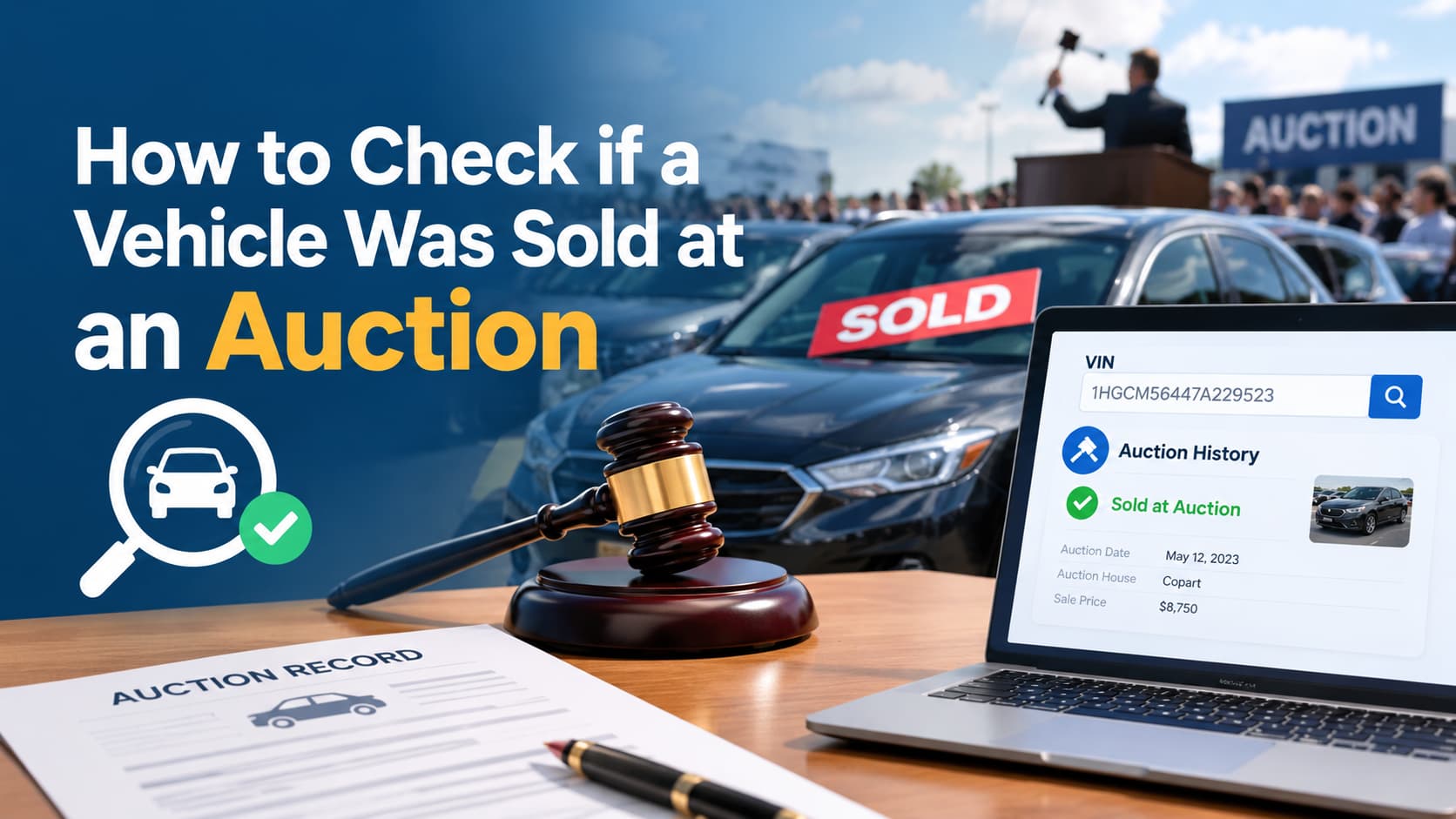
Key Takeaways
- A free DVLA check will not tell you about auction history. It does not show write-off category, salvage history, auction records, outstanding finance, or stolen status.
- A full history check is the only reliable way to confirm auction history. It can show the salvage category (A, B, S, or N) and the date it was recorded, plus auction.
- Salvage markers are permanent. A write-off record stays with the vehicle for life, however good the repair.
- Physical signs can help but prove nothing on their own. Mismatched paint, uneven panel gaps, and VIN discrepancies are reasons to dig deeper, not conclusions.
A car that has been through an auction can look perfect on a dealer forecourt. Paint matching is good, panels can be replaced, and a skilled repairer can hide serious damage. That is why a car auction check matters: it looks at records, not appearances.
This guide explains why auction history is worth checking, how to run a check using free and paid tools, what physical signs to look for at a viewing, and what the four salvage categories mean.
Why Auction History Matters
The auction industry in the United Kingdom estimates that more than 12,000 vehicles are sold at auction weekly, although the figures vary. The reasons why a vehicle is up for auction are that it was repossessed, declared a total loss, or the previous owner just wants to get rid of it due to recurring problems.
The Main Risks of Buying Blind
Buying without a check leaves you exposed to problems that are hard to see and expensive to fix. These are the ones that come up most often.
Hidden Damage and Write-Off Status
A repaired salvage car can look immaculate, with excellent paint matching and replacement panels hiding the original damage. A car may also carry a salvage category (A, B, S, or N) that the seller never mentions.
Mileage, Identity and Price Problems
Checking auction records helps you to spot if the vehicle had frequent resales and inconsistent odometer readings. If you find any VIN mismatch, it could be an early sign that a vehicle might be illegitimate.
And a repaired write-off usually sells for noticeably less than an equivalent car with a clean history, so make sure you do not pay full price.
How to Check for Auction History
Some people might not know how they can check if a vehicle was previously sold at an auction. Well, you have two options: a free check and a paid report. You can start with a free check to get the basic information, then use a premium history check to look for auction records and write-off categories.
Important: A free check is a good start, but only a full check reveals auction history.
Step 1: Run a Free DVLA Check
The DVLA’s vehicle enquiry service gives you basic vehicle details from the registration number. It is free, instant, and a sensible first step to confirm the car is what the advert says it is.
What it will not do is tell you whether the car was ever sold at auction or written off. It does not show write-off category, salvage history, auction records, outstanding finance, or stolen status.
Step 2: Run a Full Car History Check
You can use an online car check like Smart Car Check to check a vehicle’s records, such as auction history, and check the car’s category (A, B, S, or N).
Step 3: Interpret the Results
When you read the report, look for three things:
- Write-off category. Cat A, B, S, or N tells you how the insurer classified the damage.
- Dates. When was the record created, and does it line up with the car’s MOT and service history?
- Photos and damage notes. Do the images match the repairs you can see on the car today?
If the report comes back clean, that is reassuring but not a guarantee. Records can be incomplete, and not every auction sale involves an insurer.
READ ALSO: Understanding Insurance Write-Off Categories in the UK
Physical Signs of a Previously Auctioned Car
A history check is the reliable route, but a viewing gives you the chance to spot things a report might miss. Treat these as prompts to ask questions, not proof on their own.
Bodywork and Paint
Bodywork is where repairs are easiest to spot. Look closely at paint shade, panel gaps, and trim, because a good repair can still leave small clues that the car has had panels replaced or repainted.
What to Look For
Once you have the premium report with you, you can look for these signs:
- Mismatched paint. Compare panels in daylight and from different angles. A slightly different shade on one door or wing is worth noting.
- Uneven panel gaps. Run a finger along the gaps between panels. Consistent gaps suggest factory assembly; wide or tight spots suggest replacement.
- Overspray. Look for paint on rubber seals, trim edges, and under the bonnet.
- Replaced parts. New lights, bumpers, or wings on an older car can be innocent, but they can also point to accident repair.
VIN and Documentation
Not every vehicle is assigned the same VIN. The analogy is simple; think of it like human fingerprints: they might look similar, but technically they are different. Check it in more than one place: on the dashboard or door frame, under the bonnet, and on the V5C logbook.
If the numbers do not match, or the VIN plate looks tampered with, verify with the seller. Also, you may check the V5C details to ensure these details match the claim: registration, make, model, colour, and VIN.
Under the Bonnet and Inside
Next, you can examine the vehicle’s engine bay, boot floor, and interior to check for signs of repair and bodywork that might be hidden. Don’t forget to check these in good lighting to make sure you do not miss anything.
What to Look For
- Look for fresh underseal or sealant in the engine bay, which can hide structural repair.
- Check the boot floor and spare wheel well for creases or fresh paint.
- Look at the interior for signs of water damage, such as damp smells or misted windows.
- Check that the mileage on the odometer is consistent with the MOT history and service records.
READ ALSO: How To Check a Car’s History In The UK? Easiest Ways To Do So
Understanding Salvage Categories
If a check shows a salvage record, the category tells you how serious the damage was judged to be. The four current categories come from the Association of British Insurers (ABI).
| Category | What It Means | Can It Return to the Road? |
|---|---|---|
| Cat A | Scrapped entirely. Not even parts may be salvaged. | No |
| Cat B | The body shell must be crushed, but undamaged mechanical and electrical parts can be recovered. | No |
| Cat S | Structural damage, such as to chassis legs, crumple zones, or suspension mounting points. Repairable. | Yes, once properly repaired |
| Cat N | Non-structural damage: cosmetic, electrical, or mechanical. The most common repairable grade. | Yes, once properly repaired |
A few practical points follow from this:
- Cat S and Cat N cars can be driven legally once properly repaired.
- The marker is permanent. It stays on the vehicle’s record for life, however good the repair.
- Older cars may show Cat C or Cat D. Before October 2017, the repairable bands were called Cat C and Cat D, so you will still see those on older records.
If you are looking at a Cat S car, the quality of the structural repair is everything. That is not something a report can confirm for you.
What to Do If You Find Auction History
If you find an auction history on the car, you do not need to walk away immediately. If the car has proper service and maintenance history, a well-repaired past can still be a sensible purchase at the right price.
Ask the Seller Directly
Give them the chance to explain. A seller who knew about the history and priced accordingly is very different from one who hid it. Ask when the damage happened, who repaired it, and whether they have any paperwork. If the seller is hesitant to answer, be aware.
Adjust Your Offer
A repaired write-off usually sells for noticeably less than an equivalent car with a clean history, with Cat S typically discounted more than Cat N. If the asking price ignores that, you are overpaying.
Verify the Repairs
Ask for the repair invoice, photos of the damage before repair, and any engineer’s report. If the seller cannot provide them, factor that in.
Get an Independent Inspection
This matters most for Cat S cars, where structural repair quality is the main risk. A qualified inspector can look at things a report cannot.
Check Insurance Before You Commit
Some insurers decline previously written-off cars; others charge more or insist on an engineer’s inspection. Confirm cover and cost before you buy, not after.
Think About Resale
The salvage record stays with the car, so you will face the same questions when you sell. Budget for that discount now.
Run a Full Report Before You Decide
If you are still deciding, run a full car check report first. It is far cheaper than discovering the problem after you have paid.
Check the Records, Then Trust Your Eyes
A car auction check is one of the simplest safeguards in used car buying. It takes minutes, costs little, and tells you things a test drive never will, such as whether the car was written off, when, and how seriously.
Start with the free DVLA check to confirm the basics, then use a full history check to look for auction records and the write-off category. If the report shows a category, use it to negotiate, verify the repairs, or walk away. You can run a car auction check by registration number on Smart Car Check and see the auction history, salvage category, and photos before you decide.
Frequently Asked Questions About Spotting a Car That Was Auctioned
Does a car that was sold at a salvage auction always have a write-off category?
Not always. Salvage auctions mostly sell vehicles that an insurer has declared a total loss, which means a category (A, B, S, or N) should have been recorded.
Can I see salvage auction photos for any car?
Images are only available if the vehicle was previously listed in a salvage auction and the photos were archived. If it was never auctioned, or if the records were deleted, no photos will exist.
Can a Cat S or Cat N car be driven legally?
Yes. Once properly repaired, Cat S and Cat N vehicles are legal to drive. A Cat S car must be re-registered with the DVLA first. Cat A and Cat B vehicles cannot be returned to the road at all.
Can the salvage marker ever be removed?
No. The write-off record is permanent and stays with the vehicle for life, however well it was repaired. There is no process for having it removed or cleared, so any seller who claims otherwise is wrong.
Is it worth checking a car's auction history before buying it?
Yes. A car auction check is quick and inexpensive compared with the cost of buying a repaired write-off at clean-history prices. It can reveal a salvage category, the date it was recorded, and auction photos of the damage, all of which help you negotiate, verify repairs, or walk away. You can run a check by registration number on Smart Car Check.




