

Buying a used car is more about digging up the past than looking at the present shine. Many buyers skip the hard questions only to regret it when the engine light flashes a month later. You’re not just purchasing a set of wheels. You’re inheriting a complete history.
This includes every service, every accident, every financial obligation tied to that vehicle’s Vehicle Identification Number (VIN). The goal here is simple: arm you with the precise, non-negotiable questions that turn a hopeful handshake into a confident purchase, and ensure you don’t get stuck with someone else’s expensive secret.
That’s why having a solid list of questions to ask when buying a used car is your best defence against peeling back the layers of a vehicle’s hidden past.
Confirm the Vehicle’s Legal Standing
This is non-negotiable. Before you worry about oil leaks or worn tyres, you have to establish if the car is legally safe to buy. We’ve seen too many folks hand over cash for a vehicle that technically belongs to a finance company or, worse, was reported stolen three counties over.
1. Is there any recent comprehensive car history check of the car?
Asking about the recent car history is crucial because you want to buy the best car, not a problematic car. A history report reveals past accidents and damage, major repairs, MOT history, mileage analysis, theft status, write-off history, and other hidden history.
Asking this helps you negotiate a fair price and avoid overpaying for a car that has hidden issues or a problematic history.
2. Is there any outstanding finance secured against the vehicle?
A lot of used cars are bought with financing, so they might still belong to a lender. If the seller hasn’t paid off the loan, the finance company can take the car back even after you’ve bought it. That’s why you need to check for any outstanding finance.
3. Has the car ever been reported as stolen?
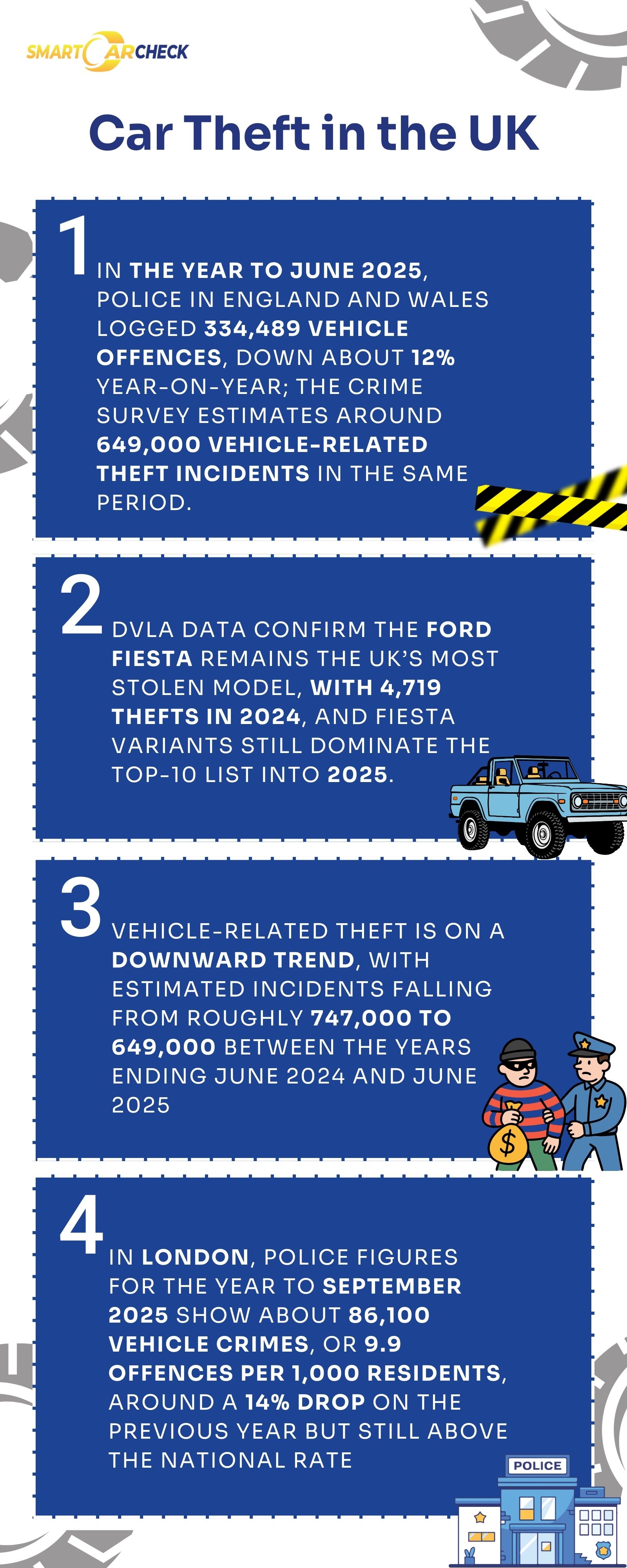
You might think you’d spot a stolen car, but modern thieves are sophisticated. They “clone” vehicles. By taking the number plates and VIN from a legitimate car and slapping them on a stolen one of the same make and model.
Ask the seller about the car’s history. If they are vague about where they got it or can’t produce the spare key, be on high alert. A stolen flag on a history report is an immediate “walk away” signal. There is no fixing that.
4. Does the VIN on the chassis match the V5C logbook and the registration plate?
A mismatch here is a serious red flag that demands immediate action. It could be a simple administrative error, sure, but it often indicates vehicle cloning or outright theft. You’d be amazed at how many people check the paintwork but never look at the VIN.
- Check the dash: Look through the bottom of the windscreen.
- Check the door jamb: Usually on the driver’s side pillar.
- Check the V5C: Does the number on the paper match the metal perfectly?
If there is even one digit off, or if the VIN plate looks scratched, glued on, or tampered with, run. That’s the hallmark of a “ringer” or a cut-and-shut job. Walk away. Do not buy that vehicle.
Document the Ownership and MOT History
The paperwork shows the true history of the car. You need to see the ownership documents and MOT history because they give you the facts about the car. A car with a thick folder of receipts is worth its weight in gold compared to one with a “lost” history.
5. Can I see the original V5C registration certificate (logbook)?
Never, and we mean never, buy a car without seeing the original V5C. Not a photocopy. Not a “picture of it.” The original.
Hold it up to the light. You’re looking for the DVL watermark. If the seller says, “It’s in the post” or “I’ve lost it, but I’ll write you a receipt,” you’re taking a massive risk. No V5C means you can’t tax the car, and it makes selling it later a nightmare. Plus, it’s the primary way to verify the seller actually lives at the address where you’re viewing the car
6. How many previous keepers are noted on the V5C?
The number of previous keepers noted on the V5C is important because it directly affects the car’s value. A lot of quick sales or a high turnover often suggests the car has expensive problems and is simply being quickly flipped.
Also, check who those owners were. A “company” owner on the logbook usually means it was a fleet vehicle or a rental. That doesn’t mean it’s bad, but it changes the context of the mileage.
7. Can you provide a full, chronological service and maintenance history?
Asking this is crucial for evaluating the car’s condition, reliability, and true value. Look specifically for official stamps, corresponding invoices, and records that show the mileage progression over time.
A seller who fails to provide a full history presents a significant red flag; while not illegal, a lack of documentation strongly suggests neglect, often leading to expensive, hidden mechanical issues down the road.
8. When was the last MOT test, and can I see the full MOT history?
The MOT certificate is just a record of the car on one day. If you want to see the history, you can check this MOT online, and you should do it before you even meet the seller.
Look at the advisories. If last year’s MOT said “brake pads wearing thin” and this year’s receipt doesn’t show they were changed, you know you’re about to foot that bill. Recurring failures for suspension or emissions suggest a car that’s been neglected.
Confirm the Mileage and Usage Details
Odometer fraud (clocking) is rising again. Digital odometers are surprisingly easy to hack. You need to play detective to make sure the car has done the miles it claims. If you’re concerned about buying a car with fraudulent mileage, and curious about what questions to ask when buying a used car, see the list below:
9. What is the current, exact mileage, and why does it align with the MOT records?
Ask the seller for the mileage before you arrive, then check it against the MOT history. Does the progression make sense?
The smooth curve: Most cars do 10k–12k miles a year.
The anomaly: If a car did 15k a year for three years, and then suddenly only 2k miles the next year, ask why. Was it sitting in a garage, or was it clocked?
We’ve seen cars with 180,000 miles wound back to 60,000. That difference is dangerous because parts like the timing chain are time bombs at higher mileage.
10. Was the car ever used for business purposes, such as a taxi, a hire car, or a fleet vehicle?
Private sellers might not volunteer this info, but it’s crucial. A car used as a minicab might have “low” mileage if it was just city hops, but the engine has idled for thousands of hours. That wear doesn’t show on the clock.
Check the V5C for previous corporate owners, and look for signs of decal removal on the doors or heavy wear in the rear seats where passengers would slide in and out. High usage usually means more significant wear and tear and a higher likelihood of being driven by multiple, less careful people.
11. Where were most of the driving accumulated: urban, or motorway miles?
Motorway (highway) miles generally cause less wear and tear on things like the clutch, brakes, and transmission compared to heavy stop-and-go city traffic. The car’s overall internal condition is often better predicted by how it was actually driven, not just the number on the odometer.
12. Does the general wear and tear on the pedals and steering wheel match the mileage on the clock?
A car showing a low-mileage reading should not have a steering wheel worn smooth or pedals significantly ground down. This mismatch is a major red flag for odometer tampering every time.
Besides the mileage lie, clocking can hide mechanical issues and a history of poor maintenance, putting that vehicle closer to a major breakdown than you realize. That’s why checking the mileage is important.
Investigate Accident and Structural Damage
Investigating past accidents and structural damage is important for three main reasons:
- Safety
- Finance
- Performance
Undisclosed damage, or repairs performed cheaply and poorly, creates serious safety risks because of the car’s structural integrity.
13. Has the car ever been involved in an accident or sustained any significant body damage?
By asking this, you can know the potential safety issues that could affect the car’s value and increase future insurance costs. If the car has an accident history, especially if poorly repaired, it could mean the car has structural damage that isn’t immediately visible but could lead to costly mechanical problems later.
14. If it was an insurance write-off, what was the category, and can you provide documentation of the professional repairs?
If the car write-off history check reveals it was written off, the category is everything. Category N (non-structural) or Category S (structural) are the most common write-off statuses today. We strongly advise extreme caution with any structural write-off, Category S.
If the car has been repaired and put back on the road, you need proof that the work was done by a competent specialist. Demand invoices and photos detailing the repair process. Ask if the vehicle has passed a Vehicle Identity Check (VIC), although this requirement has changed over the years; any evidence of rigorous post-accident inspection is good.
15. Have any parts, particularly the body panels, been replaced or repainted?
The question is a verification tool. The seller’s answer, combined with a physical inspection of replaced or repainted body panels when buying a used car, is important because it provides insight into the vehicle’s history, the extent of past damage, the quality of repairs, and the potential impact on the car’s value.
16. Are there any known issues with the chassis or underbody structure?
Asking about issues with a used car’s chassis or underbody structure is critical because these components form the vehicle’s foundation and directly relate to safety, long-term reliability, and overall value.
Problems in these areas can be expensive, difficult to repair, or even indicate that the car is unsafe to drive. By asking this question, you are protecting your safety and your financial investment.
Confirming the Mechanical Condition and Faults
You can learn so much about the car from the seller’s story, but the car itself needs to confirm those details. A thorough physical inspection and a rigorous test drive are the way you confirm those details.
Assessing the mechanical condition prevents unexpected, costly repairs, ensures your safety, and frankly, provides powerful leverage for price negotiation.
17. Are there any known mechanical issues, warning lights, or unusual quirks you haven’t disclosed?
By asking this question, you shift the burden of disclosure onto the seller. This ensures you have the necessary information to make a well-informed decision. Knowing about existing faults gives you leverage to negotiate a lower price or request that the seller fix the problems before the sale, and helps you anticipate future maintenance needs and budget accordingly.
18. Do you happen to know when the timing belt or chain was last replaced, if applicable?
This is critical. On many modern engines, if the timing belt snaps or the chain fails, the pistons often collide with the valves, leading to a completely destroyed cylinder head and a very costly repair.
If the seller doesn’t know when the timing belt or chain was last changed, assume it needs to be done soon or hasn’t been replaced at all. Not knowing this is a big warning sign and should make you think twice.
A used car with an unknown or overdue timing belt history can be a “ticking time bomb”. The impending replacement cost is a powerful bargaining tool; use it to negotiate a lower price on the car.
19. What condition are the tyres in, and when were they last replaced?
This tells you how well the car has been maintained and helps you plan for future or old costs. Worn tyres are expensive to replace and may be unsafe, even if they look fine. This lets you factor this expense into the negotiation or, if they’re severely problematic, walk away entirely.
20. Have all required manufacturer safety recalls been completed?
Unresolved recalls can point to dangerous defects. In the UK, it’s illegal for dealerships to sell a car with an outstanding safety recall until the issue is fixed. Driving a car with an unresolved safety recall could potentially invalidate your insurance, plus it lowers the car’s resale value.
21. Would you agree to an independent pre-purchase inspection by my trusted mechanic?
When a seller willingly agrees to an independent mechanic checking the car, it instills confidence, confirms the vehicle is likely in good shape, and helps you negotiate the final price based on fact. If they suddenly become unavailable, change the subject, or say, “My mechanic already checked it,” then you should be extremely suspicious.
Offer to pay for the inspection yourself; it is your insurance policy. A mechanic will put the car on a ramp and check for issues you can’t see, like perished brake lines, rust on the suspension arms, or gearbox leaks.
READ ALSO: What is the Average Cost of a Full Car Service in the UK?
Check the Financial and Administrative Future
The cost of owning the car doesn’t end with the purchase price, you know. You need to understand the ongoing legal and financial obligations tied to it, especially regarding things like emissions standards and Vehicle Excise Duty (VED, or road tax). Understanding the administrative future of a used car is essential because it helps you uncover hidden liabilities, confirm legal ownership, and avoid future legal and financial problems.
22. What is the car’s Euro emissions standard, and is it compliant with ULEZ or similar Clean Air Zone requirements?
Knowing about a used car’s Euro emissions standard and ULEZ (Ultra Low Emission Zone) compliance is crucial right now to avoid potential daily charges. Clean Air Zones are expanding in UK cities, and you don’t want to purchase a car you can’t legally or affordably drive where you need to go.
If a seller doesn’t know the compliance status, you should use a ULEZ checker yourself.
23. What is the yearly Vehicle Excise Duty (road tax) cost for this model?
Asking about the annual VED cost is critical for budgeting; this isn’t a flat rate. It varies widely. Models registered before April 2017 are usually taxed based purely on emissions, while newer cars have a different system, often including an additional “premium” tax if the original list price was over £40,000. It’s a significant annual expense you must factor in.
24. Is the car still covered by the manufacturer’s warranty, and is it transferable to a new owner?
It’s important to ask about any remaining warranty coverage. It provides a crucial, protective layer against unexpected and expensive repairs. You must confirm that this coverage is actually transferable to you as the new owner (terms may vary), as inheriting a vehicle that is no longer covered could mean facing immediate, costly repair bills.
25. Are there two sets of keys and the owner’s manual in the glovebox?
Losing the spare key to a modern car can cost hundreds of pounds to replace and reprogram. A missing spare key is also a small red flag that the seller might not be the real owner, and make sure both keys work, especially the remote central locking.
A car without the owner’s manual means you’ll be hunting online for basic controls and maintenance schedules.
Timing and Tactics: When to Buy and How to Negotiate
Next, we’ll move on to questions that aren’t addressed to sellers or dealers, but are the sort of things first-time used car buyers often wonder about. Sometimes, saving money has nothing to do with the car itself and everything to do with the calendar. Knowing when dealers are under pressure gives you serious leverage.
26. What is the cheapest month to buy a used car?
Generally, the quietest time of year is best for the buyer because dealers need to hit their targets.
December:
The end of the year is when dealers are most motivated to meet their annual sales quotas. Most people are focused on Christmas, meaning less competition for you. They may even sell a car at a loss just to secure a large year-end bonus.
February and August:
These are the quiet months right before the new UK registration plates are released in March and September. People are trading in their old cars, flooding the used market, and increasing supply. Dealers need to clear stock, which drives prices down on older plates.
The End of the Quarter:
The last few days of March, June, September, and December are always the best time to negotiate, especially with a dealership. Sales managers are desperate to meet those quarterly sales targets.
27. Is the car following the 20/3/8 Rule?
This is a simple but strict guideline that financial advisors use to keep you from becoming “car poor.”
20% Down Payment:
You should pay at least 20% of the car’s purchase price upfront. This reduces the loan amount, lowers your monthly payments, and helps you avoid falling into negative equity (where you owe more than the car is worth) because cars depreciate so quickly.
3-Year Loan Term:
Limit your car finance agreement to a maximum of three years or less. Longer loans mean you pay significantly more interest, and the risk of negative equity increases massively, especially on new or nearly-new cars.
8% of Gross Monthly Income
The total monthly cost of your car (including your finance payment, insurance, fuel, and estimated maintenance fund) should not exceed 8% of your gross monthly income. This ensures the car expense doesn’t compromise your other essential financial stability.
For example:
If your gross monthly income is £3,000, your total monthly car costs (e.g., payment, insurance, fuel) should not exceed £240. Sticking to this prevents you from being surprised by the true cost of car ownership.
28. What are the biggest mistakes first-time buyers make?
After decades of digging through data, we can tell you the single biggest mistake first-time buyers make is falling in love with the car before checking the data. They view the vehicle, they smell the interior, they hear the vroom, and their critical brain shuts off.
- They skip the history check because they trust the seller’s smile.
- They don’t get the PPI because they feel rude to ask the seller to drive to a mechanic.
- They ignore the service history gap because the paintwork is shiny.
Buying blind is like revving an engine without oil, meaning it’s going to end badly. The car check and the independent inspection must happen before you allow yourself to imagine driving the car home.
Final Thought on Questions To Ask When Buying a Used Car
At the end of the day, success in buying a used car comes down to risk mitigation. While your questions provide a foundation of knowledge, relying solely on a seller’s response can leave gaps.
You use your questions to require the seller to show you the car’s actual condition, but the most efficient, non-negotiable step is verifying those claims independently. Frankly, relying on a seller’s potentially selective memory or cooperation is always a risk.
That’s why running a vehicle history check is mandatory. It gives you instant, objective data pulled from official records. Not just what the seller wants you to know. Run the VIN or the Reg number, trust the data, and drive away knowing the full story.




